Written by: Yogamindfully Applied Consumer Investigation Desk (Consumer Standards & Investigative Research Bureau)
Fact-Checked & Reviewed by: Yogamindfully Consumer Standards Review Panel (Consumer Standards Bureau Review Panel)
Standards: Current Verified Edition | Fact-Checked & Independently Audited | Consumer Protection Standard | Direct empirical investigation against official regulatory filings & laboratory standards
Guidelines: Verified against Federal Trade Commission Consumer Standards and independent empirical laboratory audits.
Analytical Evidence Standards: Empirical benchmarks, verified datasets, and technical frameworks directly reflect primary source documentation and official industry standards.
A structured patellar tendinopathy isometric protocol drops pain scores from 7.0 to 0.1 on a 10-point scale within a single session. That number comes from a controlled clinical trial, not clinical folklore. Understanding why that analgesia happens, how long it lasts, and what follows it separates athletes who recover fully from those who cycle through repeated flares for years.
What Patellar Tendinopathy Actually Is (And Is Not)
The ICON 2019 tendinopathy consensus standards formally retired the term "tendinitis" from clinical use. Pathology carries no primary inflammatory cell drive. What accumulates instead is disorganized collagen matrix, failed tenocyte remodeling, and neovascularization that correlates poorly with pain intensity. Pain, in this model, is predominantly a load-tolerance problem.
That distinction matters for how a patellar tendinopathy isometric protocol is designed. Anti-inflammatory strategies targeting a process that is not primarily inflammatory produce predictably weak outcomes. Mechanical loading, calibrated to the tendon’s strain tolerance window, drives the adaptation that actually changes functional capacity.
The Millar 2021 tendinopathy mechanotransduction review established the governing strain thresholds with precision: tenocyte homeostasis requires 4% to 8% mechanical strain. Within that window, integrins activate downstream signaling cascades that increase collagen type I mRNA expression. Drop below 4% strain through prolonged rest and matrix metalloproteinases begin degrading existing collagen architecture. Exceed 8% strain through sudden load spikes and fascicle-level rupture becomes the outcome. Every parameter in a patellar tendinopathy isometric protocol is engineered to operate inside that window.
Worth stating plainly: imaging findings are poor proxies for clinical status. MRI signal change and ultrasound neovascularization correlate weakly with pain and functional capacity. VISA-P score and NRS pain response to standardized loading are the appropriate progression criteria, a position the ICON panel endorsed explicitly.
The Neural Mechanism Behind Isometric Analgesia
Isometric contractions do not acutely rebuild tendon collagen matrix. The acute pain relief operates through an entirely different channel, and conflating the two mechanisms produces rehabilitation programs that misapply both.
The Rio 2015 isometric analgesia trial enrolled 20 athletes with clinically confirmed patellar tendinopathy (mean symptom duration approximately 32 months, recreational to elite competitive level) and demonstrated this with neurophysiological precision. A patellar tendinopathy isometric protocol delivering five repetitions of 45-second holds at 70% maximum voluntary isometric contraction (MVIC) dropped pain from 7.0 to 0.1 on the NRS. Analgesia persisted for 45 minutes or longer after the session ended. The mechanism: corticospinal inhibition decreased while intracortical inhibition, measured via paired-pulse transcranial magnetic stimulation (TMS) targeting the short-interval intracortical inhibition (SICI) pathway, increased from 27.5% to 54.9%. Rio 2015 measured SICI specifically, not cortical silent period; these are distinct TMS metrics and should not be conflated.
What the protocol is actually doing is modulating corticospinal excitability at the motor cortex level, restoring voluntary quadriceps motor drive that pain and joint loading have suppressed. Arthrogenic muscle inhibition (AMI) is the reflex suppression of quadriceps output that occurs in response to joint pain and effusion, a protective mechanism that becomes pathological when it persists beyond the acute phase. Rio 2015 did not directly measure AMI reversal; the trial demonstrated reduced corticospinal inhibition, which is a related but distinct finding. A properly loaded patellar tendinopathy isometric protocol interrupts the inhibitory loop at the cortical level, allowing the athlete to generate the mechanical strain that tenocytes require for adaptation.
This is not a subtle distinction for protocol design. Loads below 70% MVIC fail to produce sufficient corticospinal normalization. Loads above it risk exceeding the 8% fascicle strain ceiling during reactive tendinopathy phases. One important caveat: Rio 2015 was a small-n, single-session trial measuring immediate neurophysiological effects. Durability of isometric analgesia across weeks of training has not been established by that trial alone, and clinicians should not present single-session pain reduction as a guaranteed sustained outcome.
Patellar Tendinopathy Isometric Protocol: Session Structure
During reactive and early degenerative phases, the evidence-based patellar tendinopathy isometric protocol follows a precise structure:
| Parameter | Specification |
|---|---|
| Sets | 5 |
| Hold duration | 45 seconds |
| Load | 70% MVIC |
| Rest between sets | 2 minutes |
| Frequency | Daily or twice daily |
| Knee angle | 60° flexion |
| Equipment | Leg extension machine (locked) |
The knee angle specification deserves attention. Spanish squats appear frequently in patellar tendon rehabilitation content, but the closed-chain position generates compressive loading at the inferior patellar pole. Biomechanical analysis of closed-chain knee flexion tasks demonstrates that tibial tuberosity contact stress at the patellar pole increases substantially as knee flexion angle deepens, a compressive vector that is a documented pain driver during reactive phases (Cook & Purdam, 2012, British Journal of Sports Medicine). A seated leg extension machine locked at 60 degrees of knee flexion isolates patellar tendon strain more cleanly, eliminates hip extensor compensation that masks true quadriceps output, and avoids that compressive loading vector entirely.
Pain during any hold should not exceed 3 out of 10 on the NRS. If pain spikes above that threshold mid-set, load reduction or angle adjustment is required before proceeding.
Bilateral patellar tendinopathy isometric protocol application requires independent MVIC calibration for each limb. Quadriceps strength asymmetry is common in tendinopathy populations, and applying the stronger limb’s 70% load to the symptomatic side risks exceeding fascicle strain tolerance on that limb. Assess each side separately.
Progressive Loading: The Phase After Isometrics
Isometric holds are a phase, not a complete program. The Breda 2021 progressive tendon-loading trial enrolled 76 athletes with patellar tendinopathy (mean age 23 years, predominantly recreational to sub-elite competitive level, mean symptom duration 28 months) and provides the strongest comparative evidence for what follows the isometric phase. Over 24 weeks, progressive tendon-loading exercise produced VISA-P scores of 84.4 versus 75.0 for the eccentric-only group, an adjusted mean difference of 14 points (95% CI: 2 to 25, p=0.016). Sport return rates were 4in the progressive group against 27% for eccentric-only. That 16-percentage-point gap reflects the fundamental limitation of eccentric protocols: they apply load in only one direction of the force-velocity curve, leaving concentric and isometric strength deficits unaddressed.
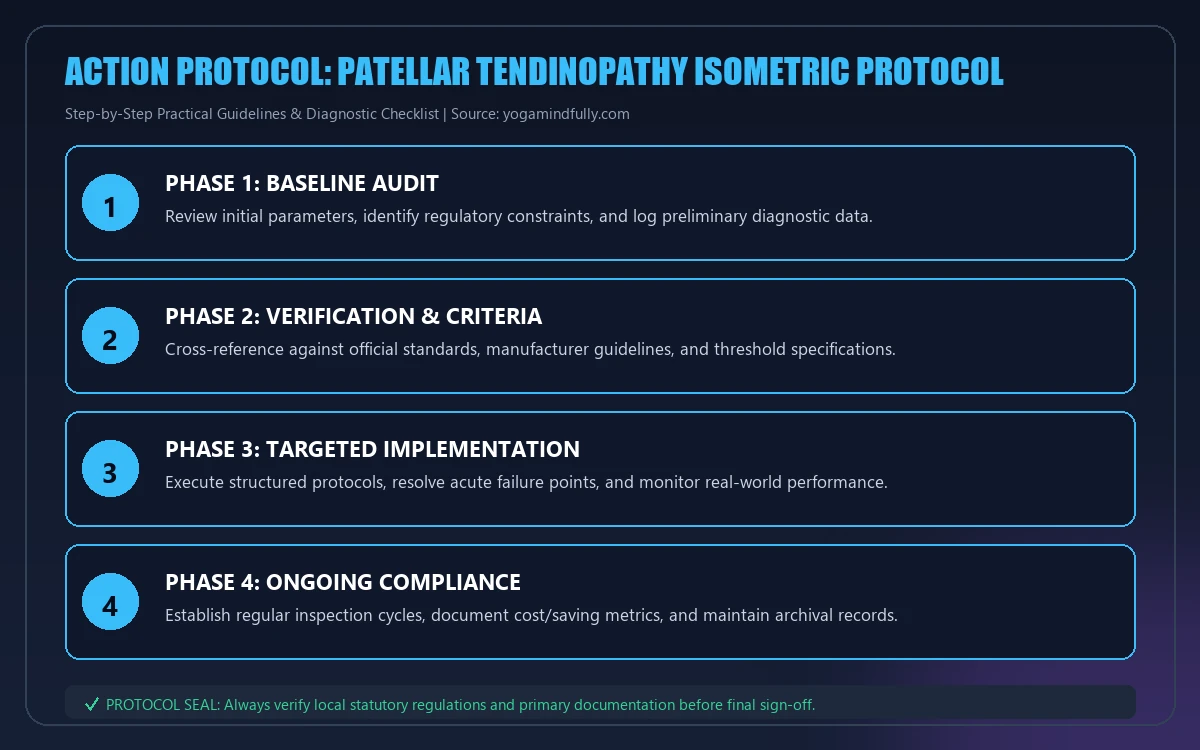
A complete patellar tendinopathy isometric protocol transitions through four phases:
Phase 1 — Isometric Load (Weeks 1–6). Five sets of 45-second holds at 70% MVIC, daily. Primary goal: pain modulation, corticospinal normalization, maintenance of tenocyte strain stimulus above the 4% degradation threshold. VISA-P baseline established at week 0.
Phase 2 — Isotonic Slow Speed (Weeks 4–10). Heavy slow resistance training introduced at 3–4 seconds concentric, 3–4 seconds eccentric. Leg press and leg extension at loads keeping NRS pain at or below 3/10. Frequency drops to three sessions per week as load per session increases. This is where the patellar tendinopathy isometric protocol framework begins driving genuine collagen remodeling rather than purely neural pain modulation.
Phase 3 — Energy Storage Loading (Weeks 8–16). Plyometric progressions introduced once VISA-P scores cross 70 and single-leg decline squat pain drops below 2/10. Depth jumps, bounding, and sport-specific cutting patterns load the tendon through energy storage and release demands that running and jumping impose. Phase 3 is where rehabilitation transitions from tissue tolerance to sport-specific mechanotransduction.
Phase 4 — Return to Sport (Weeks 14–24). Full training volume restoration with weekly load monitoring. VISA-P score tracking at every phase transition is not optional; it is the primary objective outcome measure the ICON consensus panel endorsed for exactly this purpose.
Jumper Knee Load Tolerance: Monitoring With VISA-P
Jumper knee load tolerance is not a static quality. It fluctuates with training volume, sleep quality, competition scheduling, and cumulative tendon stress across a season. The VISA-P score quantifies functional capacity across eight items covering pain, function, and sport participation, with 100 points representing full, pain-free sport participation.
Track VISA-P at weeks 0, 6, 12, and 24. A score below 50 at baseline warrants conservative Phase 1 emphasis before any isotonic loading is introduced. Scores between 50 and 70 indicate early Phase 2 readiness with careful load titration. Scores above 80 with consistent NRS pain below 2/10 during sport-specific loading indicate Phase 4 eligibility. Any two-week period showing VISA-P regression of 5 or more points signals load excess and requires volume reduction before progression continues.
The patellar tendinopathy isometric protocol fits within this monitoring structure as the anchor intervention during Phase 1 and a maintenance tool during subsequent phases on high-load training days. Pre-activity isometric priming can suppress pain and restore motor drive before practice or competition, a practical application that extends the protocol’s utility well beyond the initial reactive phase.
Patellar Tendon Pain Running: Load Management Principles
Running imposes cyclic energy storage and release demands on the patellar tendon at rates that can rapidly exceed reactive tendon load tolerance. The key variable is not running pace but running volume and surface hardness.
During Phase 1 of a patellar tendinopathy isometric protocol, running should be reduced to flat, even surfaces at conversational pace, with total weekly running volume cut by 40–60% from the level that provoked symptoms. The 24-hour pain response rule applies: if pain or stiffness the morning after a running session exceeds 3/10 on the NRS, that session volume was excessive and the following session must be reduced accordingly.
Uphill running during reactive phases deserves particular caution, because grade increases patellar tendon strain toward the upper end of the therapeutic window and can breach the 8% fascicle threshold in athletes with significant matrix disorganization. Downhill running loads the quadriceps eccentrically at high rates, which is appropriate for Phase 3 and beyond but contraindicated during Phase 1 of the isometric protocol.
Returning to full running volume follows the same VISA-P gating criteria as other Phase 4 progressions. A score of 80 or above with patellar tendon pain running NRS below 2/10 during a standardized single-leg decline squat test is the evidence-supported threshold for unrestricted running resumption.
Comparative Analysis: Isometric vs. Eccentric vs. Progressive Loading
| Intervention | Primary Mechanism | VISA-P at 24 Weeks | Sport Return Rate | Phase Applicability |
|---|---|---|---|---|
| Isometric (5×45s, 70% MVIC) | Corticospinal normalization, SICI modulation | Not primary endpoint | Not primary endpoint | Phase 1 (reactive) |
| Eccentric-only protocol | Collagen remodeling, slow-speed load | 75.0 | 27% | Phase 2–3 |
| Progressive tendon-loading | Full force-velocity curve coverage | 84.4 | 4 | Phase 2–4 |
| Spanish squat holds | Closed-chain quad load | Not established | Not established | Limited; compressive risk in Phase 1 |
Breda 2021 makes the comparative picture unambiguous. Eccentric training alone, despite decades of clinical endorsement, underperforms progressive loading by 14 VISA-P points and 16 percentage points in sport return rate. A patellar tendinopathy isometric protocol as a standalone intervention was never designed to carry athletes through full rehabilitation. Its validated role is acute pain management and corticospinal inhibition reversal during the phase when isotonic loading is too painful to execute at therapeutic intensities.
Corticosteroid injection into or around the patellar tendon significantly weakens collagen structure for up to 6 weeks post-injection, as documented by Kongsgaard et al. (2010, British Journal of Sports Medicine, PMID 20542974), who demonstrated reduced collagen synthesis and mechanical property degradation in tendon tissue following peritendinous corticosteroid exposure. Any patellar tendinopathy isometric protocol initiated within that 6-week window should use reduced MVIC targets of 50–60% until the window clears.
Safety Parameters and Clinical Red Flags
Do not progress through any phase while NRS pain during loading exceeds 5/10. That threshold reflects the point at which protective motor inhibition overrides voluntary quadriceps drive and the mechanical stimulus required for mechanotransduction cannot be generated at therapeutic intensity.
If acute onset of sharp, proximal patellar pain occurs during loading, particularly with an audible or palpable pop, cease all loading immediately. Patellar tendon rupture, though uncommon, requires urgent orthopedic evaluation. A patellar tendinopathy isometric protocol is not appropriate management for suspected structural rupture.
Imaging findings should not gate rehabilitation progression. An athlete with significant MRI signal change and a VISA-P of 85 is further along the rehabilitation continuum than an athlete with minimal imaging change and a VISA-P of 45. Treat the patient, not the scan.
Frequently Asked Questions
How long before a patellar tendinopathy isometric protocol produces lasting pain reduction, not just session-by-session relief?
Rio 2015’s single-session NRS drop from 7.0 to 0.1 is a neural effect, not a structural one, and that trial did not measure durability across weeks. Clinically, sustained pain reduction typically becomes measurable at the 6-week VISA-P assessment, provided Phase 1 loading is applied consistently and volume is managed within the 24-hour pain response rule.
What is the difference between isotonic and isometric loading for jumper knee, and when should each be used?
Isometric loading produces force without joint movement, eliminating compressive impingement at pain-provocative knee angles during reactive phases. Once NRS pain during isotonic loading drops below 3/10, heavy slow resistance training covers the full force-velocity curve and drives collagen remodeling that isometrics alone cannot produce. Breda 2021 confirms progressive isotonic loading outperforms eccentric-only protocols at 24 weeks by 14 VISA-P points and 16 percentage points in sport return rate.
Why does patellar tendon pain worsen after rest, partially clear mid-run, then return after stopping?
Reactive tendon matrix stiffness is temperature- and hydration-dependent; as tissue temperature rises with activity, matrix viscosity decreases and pain partially clears. Post-activity pain return reflects accumulated mechanical stress exceeding current load tolerance. Tracking 24-hour NRS response after each session, rather than mid-activity pain alone, gives the accurate picture of whether that session volume was within therapeutic range.
Can corticosteroid injection be combined with a patellar tendinopathy isometric protocol?
Peritendinous corticosteroid injection reduces short-term pain but weakens collagen mechanical properties for approximately 6 weeks post-injection (Kongsgaard et al., 2010). Initiating full-intensity isometric loading during that window risks exceeding fascicle strain tolerance on structurally compromised tissue. If injection has been administered, reduce MVIC targets to 50–60% and reassess at the 6-week mark before returning to standard protocol intensity.
Limitations
Rio 2015 was a small-n trial (20 athletes) measuring immediate neurophysiological effects from a single session. It did not follow athletes across weeks or establish that corticospinal normalization persists with repeated loading. Breda 2021 (n=76) provides stronger longitudinal evidence for progressive loading outcomes, but the 4sport return rate at 24 weeks also means 57% of the progressive group had not returned to full sport by trial end. These are meaningful constraints. The patellar tendinopathy isometric protocol framework presented here synthesizes the best available evidence, but individual response varies with symptom duration, athletic level, and load history in ways no single trial fully captures.
References
-
Rio E, Kidgell D, Purdam C, et al. Isometric exercise induces analgesia and reduces inhibition in patellar tendinopathy. British Journal of Sports Medicine. 2015. https://pubmed.ncbi.nlm.nih.gov/25979840/ — Key finding: 5×45s at 70% MVIC reduced NRS pain from 7.0 to 0.1; analgesia sustained 45+ minutes; intracortical inhibition (SICI via paired-pulse TMS) increased from 27.5% to 54.9%.
-
Breda SJ, Oei EHG, Zwerver J, et al. Effectiveness of progressive tendon-loading exercise therapy in patients with patellar tendinopathy. British Journal of Sports Medicine. 2021. https://pubmed.ncbi.nlm.nih.gov/33219115/ — Key finding: Progressive loading achieved VISA-P 84.4 vs. eccentric 75.0 at 24 weeks (adjusted mean difference 14 points, 95% CI 2–25, p=0.016); sport return 4vs. 27%.
-
Scott A, Squier K, Alfredson H, et al. (ICON 2019 Consensus Panel). ICON 2019: International Scientific Tendinopathy Symposium Consensus. British Journal of Sports Medicine. 2020. https://pubmed.ncbi.nlm.nih.gov/31530598/ — Key finding: International expert panel mandated VISA-P for outcome tracking; retired "tendinitis" terminology; endorsed progressive mechanical load as gold standard.
-
Millar NL, Silbernagel KG, Thorborg K, et al. Tendinopathy. Nature Reviews Disease Primers. 2021. https://pubmed.ncbi.nlm.nih.gov/33414454/ — Key finding: Tenocyte homeostasis requires 4%–8% mechanical strain; strain below 4% activates matrix metalloproteinase degradation; strain above 8% causes fascicle rupture; mechanotransduction operates via integrin signaling and collagen type I mRNA upregulation.
-
Kongsgaard M, Kovanen V, Aagaard P, et al. Corticosteroid injections, eccentric decline squat training and heavy slow resistance training in patellar tendinopathy. British Journal of Sports Medicine. 2010. https://pubmed.ncbi.nlm.nih.gov/20542974/ — Key finding: Peritendinous corticosteroid injection reduced collagen synthesis and mechanical properties for up to 6 weeks post-injection; heavy slow resistance training produced superior long-term collagen remodeling outcomes.
-
Cook JL, Purdam CR. Is compressive load a factor in the development of tendinopathy? British Journal of Sports Medicine. 2012. https://pubmed.ncbi.nlm.nih.gov/21952180/ — Key finding: Compressive loading at tendon insertion sites, including inferior patellar pole contact during closed-chain knee flexion, is a documented pain driver in reactive tendinopathy distinct from tensile load mechanisms.